
Introduction
Back in 2022, Netflix released a show titled Monster: The Jeffrey Dahmer Story, written and directed by Ryan Murphy and Ian Brennan. The show starred Evan Peters, an award-winning actor, who played none other than the real-life serial killer and convicted cannibal, Jeffrey Dahmer. The series follows Dahmer’s story and upbringing through childhood poverty and a broken family life; while simultaneously flashing forward to a present timeline depicting real-life graphic murders he committed (Montgomery, 2022). Naturally, it was a global sensation. The show alone, within its first week of release, grossed 196.2 billion watching hours, conquering other popular Netflix shows, such as Stranger Things (Montgomery, 2022). However, despite the show’s intense popularity, there has been much online criticism surrounding the ethics of how the show was made. Monster: The Jeffrey Dahmer Story was made without the consent of victim’s family members, who were also portrayed in the show by actors as well (Montgomery, 2022). And while legal scholars may question why these productions can happen without permission, there are no federal copyright laws surrounding crime cases (Boling & Slakoff, 2025). And based on the numbers, people don’t really seem to care about the ethics surrounding this show at all.
But the public is not just simply watching this type of media; they are also heavily engaging with it online. In fact, people interested even have their own online name. The True Crime Community (TCC) is a self-description used by enthusiasts of true crime media on sites such as Reddit, Tumblr, and other social media (Fathallah, 2022). But these online sites are not just for the purpose of mere crime conversation; they are for public investigation. When an individual engages with any type of forensic fandom, they do not just read the story; they seek clues they might have missed to hypothesize further (Coduto, 2025). Clearly, true crime isn’t just about watching a documentary anymore; it’s about public discourse. To break down this complex media consumption and interaction phenomenon, this post will do three things: define all true crime media, analyze the parasocial community created by it, and discuss the online discourse surrounding its overall consumption.
What is True Crime Media?
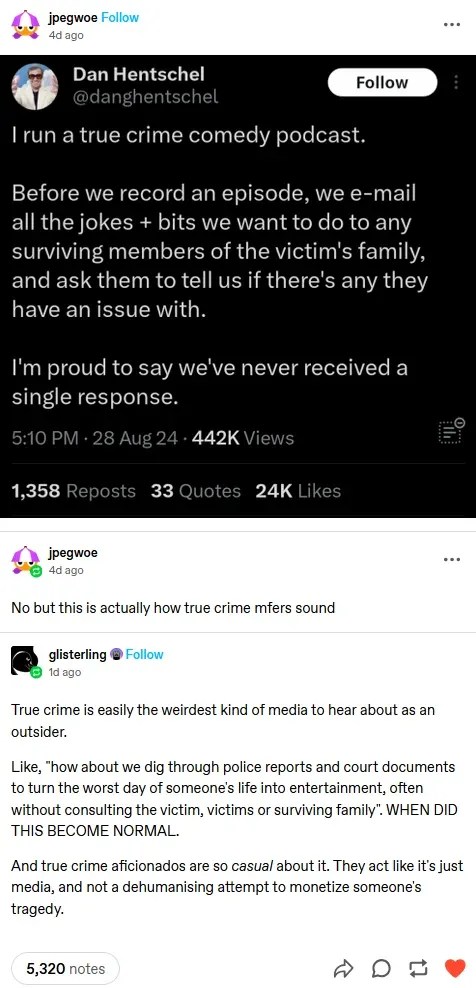
In his essay discussing the unintended negative effects of technological advancement, American media theorist Neil Postman pointed out that new technologies alter the structure of our interests, the character of our symbols, and the nature of the community in which thoughts develop (2016). Journalism, even unethical journalism, has been around forever. However, it is the media of communication and information access that have changed into a bottomless pit. New advancements in mediated communication have left the public with no privacy on the internet. Reddit doesn’t care about your privacy; they want to know how you were found dead.
Created by Sandra Petronio, communication privacy management theory (CPM) theorizes that the process of communicating private information in relationships with others becomes private disclosures (West & Turner, 2021). To put it in simpler terms, people have boundary lines with their own private information, in which they will choose to disclose or not. In interpersonal communication, this can be violated through gossiping. In True crime media online spaces, CPM boundary lines are violated by exploiting victims’ entire livelihoods and glorifying the people who ended their lives. True crime media isn’t just unethical journalism: it’s an online gossiping ring.
To define true crime media more clearly, it can be described as created forms of online communication used to violate the privacy of victims of crime. This form of media creation and consumption is easy to fall into, considering victims and perpetrators leave increasing digital footprints that allow anyone to track and follow the story (Coduto, 2025). Visibility of cases from law enforcement online networking makes it easy for consumers to stay more engaged with every new headline (Coduto, 2025). Thus, expanding the definition further, true crime media isn’t all about the creation of documentaries or podcasts. It’s actually about how the public chooses to engage with it online.
The “True Crime Community” (TCC)
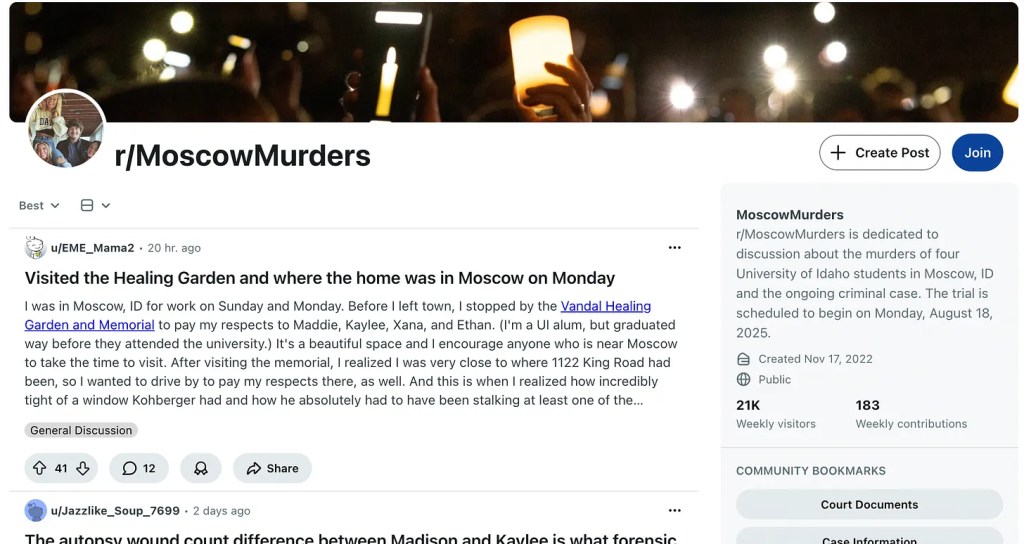
Because of social media and streaming services, we live in an extremely participatory landscape of culture and media consumerism (Boling & Slakoff, 2025). Sites such as Reddit, Substack, Tik Tok, Tumblr, and Facebook all have the ability to form online communities with niche interests. In the case of crime enthusiasts, the TCC allows for open discussion and thoughts about all kinds of cases, based on common previous media consumption being used as a blueprint to facilitate conversation. It’s simple: you listen to a podcast or watch a show, and seek out communities discussing the same thing. However, the TCC often crosses ethical boundary lines, such as proclaiming love for a serial killer or discussing victims’ personal information that isn’t even relevant to the case. These interactions amongst the TCC and co-victims create unhealthy relationships, going past the idea of participatory culture and fandoms, and seeping into a parasocial invasion of privacy (Boling & Slakoff, 2025).
But the need to invade the privacy of victims has an explanation. After all, the TCC communication style is set on finding out the explanation itself. Developed by Charles Berger and Richard Calabrese, uncertainty reduction theory (URT) is defined as the strategies people use to make themselves feel less uncertainty, or anxiety, about various situations (West & Turner, 2021). There are two strategies often used when facing uncertainty, which can be interactive or passive (West & Turner, 2021). The style the true crime community often uses is the interactive strategy. The interactive strategy is used when an observer engages in some type of effort to make direct contact with something they are unsure about, with the ultimate goal being to relieve their uncertainty (West & Turner, 2021). Through the lens of the TCC, these online communities are working to ensure that their uncertainty of justice for victims is backed up by others. For instance, podcast listeners often pick up on cues given by podcasters to look more into a case, where viewers themselves can act like a judge to consider what is just and unjust (Coduto, 2025). This ultimately influences online perceptions of a case, bringing more questions and uncertainty to various cases and co-victims involved. People have become obsessed with what is right and wrong and will stop at nothing to prove that.
The Discourse: Is the TCC Unethical?
It’s no surprise that people have an issue with the TCC playing judges and detectives online. However, what’s even more compounding is how the TCC chooses to fight back against claims of exploitation and glorification. Although supporters of true crime documentaries tend to downplay their potential to create or illuminate trauma, their arguments presuppose that trauma is an unwanted byproduct (Stoneman, 2020). Additionally, the TCC also chooses to negotiate their distance with a particular kind of true crime fan – aiming to gatekeep their community as one free of serial killer fan girls and murder-obsessed fan boys (Fathallah 2022). But regardless of their refusal to admit their unethical standpoints on privacy violations, they continue to discuss the intricate details of strangers’ lives, leaving people online baffled by how one could invade someone’s privacy in this manner. The discourse of TCC is no longer just about killers and victims – it’s about how the TCC is becoming an ethical problem.
The reason the TCC is seen as an ethical problem comes from a violation of expectations. Created by Judy Burgoon, expectancy violations theory is defined as positive or negative reward valences that can be created with the violation of one’s expectations (West & Turner, 2021). In the case of one’s privacy, those who judge the TCC come from an expectation of respecting a stranger’s private business. Airing out other people’s trauma violates their expectations on how to communicate with others in online spaces. However, the TCC violates any sort of privacy expectation with how they discuss a victim’s murder. The digital trail of information readily available online allows their people to seek more story threads and clues, eventually leading to a greater result in their mind (Coduto, 2025). The TCC doesn’t care about a violation of privacy, as long as the end result of searching is considered “just”. Because a person is dead, and the public domain is free for use, the TCC automatically thinks they can dissect a person’s murder without actually being a detective. But as the cracks unfold into the vast online discourse of ethical true crime consumption and conversation, I plan to analyze every type of TCC online discourse through the lens of ethical communication theory.
Discussion Questions
- Do you think true crime media is just a violation of privacy? How can you go deeper in defining it?
- What’s your personal stance on the consumption of true crime media?
- Do you think the TCC has gone towards a more parasocial communication style? What are your thoughts on online community threads discussing details of crime?
References
Boling, K. S., & Slakoff, D. C. (2025). “What an invasion, an immense invasion”: Examining the adverse effects of true crime media on co-victims. Crime Media Culture an International Journal. https://doi.org/10.1177/17416590251371618
Coduto, K. D. (2025). Compulsive use of social media in emerging crime news stories: Perceived channel affordances and forensic fandom. Psychology of Popular Media. https://doi.org/10.1037/ppm0000603
Fathallah, J. (2022). “BEING A FANGIRL OF A SERIAL KILLER IS NOT OK”: Gatekeeping Reddit’s True Crime Community. New Media & Society, 26(10). https://doi.org/10.1177/14614448221138768
Montgomery, H. (2022, December 30). Monster: Jeffrey Dahmer: Did TV go too far in 2022? http://Www.bbc.com. https://www.bbc.com/culture/article/20221213-monster-jeffrey-dahmer-did-tv-go-too-far-in-2022
Ousborne, J., & Postman, N. (2016). The Judgment of Thamus.” Reading Pop Culture: A Portable Anthology (pp. 151–156). Bedford/St. Martin’s; Boston, MA.
Stoneman, E., & Packer, J. (2020). Reel cruelty: Voyeurism and extra-juridical punishment in true-crime documentaries. Crime, Media, Culture: An International Journal, 17(3), 174165902095359. https://doi.org/10.1177/1741659020953596
West, R., & Turner, L. (2021). Introducing communication theory: Analysis and application. McGraw-Hill.

